
I’m sure you’re familiar with the story of some kids who were told to play in a great big field. Most of them huddled in the middle of the field for fear of getting lost if they ventured too far or because they had no idea what was really out there waiting to gobble them up!
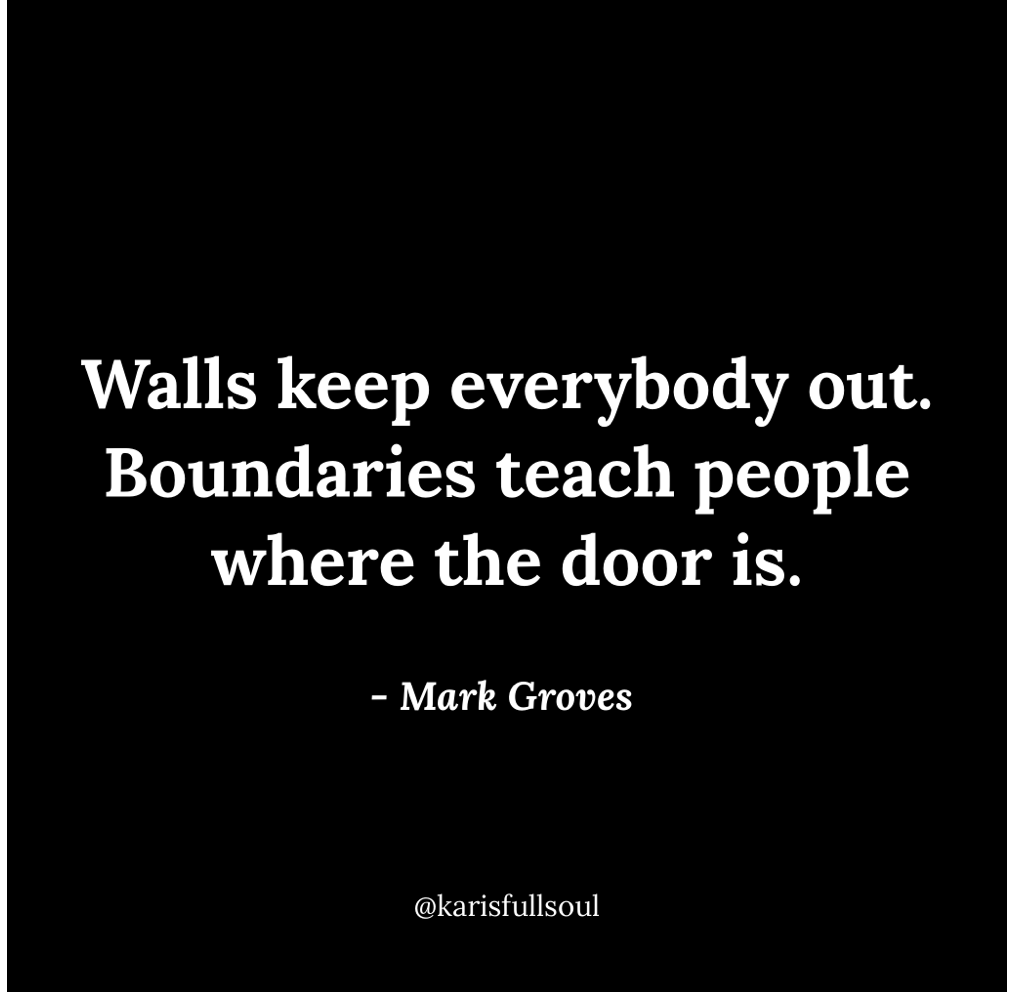
One day a fence was erected closing off an area in which the kids could play safely. They happily went all the way up to the fence, some even climbing bravely up on the fence to look what was beyond. What changed was not the terrain they were playing on, nor the actual place that they were given to play. What was different now was the safety of a boundary that not only prevented them going too far but also prevented unwelcome entities coming in.
Some might argue that boundaries are stifling adventure and freedom. I would like to show you a glimpse from the other side of this argument.
What is a boundary and why are they necessary?
I recently found myself in a situation that caused me discomfort in a friendship. I realised a bit too late that unless I set up a boundary, the friend in question was not going to respond to my needs in the friendship. What was happening was a frustration that was building up with each and every encounter we had. Her needs were being met and I was walking away feeling depleted and angry. I had to set up a boundary line in order to salvage the relationship long term- if I had allowed things to carry on this friendship would be destroyed forever without a chance to heal.
It is never easy to tell a person that their behaviour makes you uncomfortable especially if that behaviour has been allowed for a long period of time. Hard, however does not mean impossible!
My self respect and my needs are determined only by me- please do not make the mistake of assuming the rest of the world will be eager and willing to accommodate you if you don’t accommodate yourself and make your needs important.
There are ways and means to setting up boundaries that do not involve anger, rudeness or cruelty. The person or behaviour you are drawing the boundary line in front of will more than likely take offence no matter how you speak your truth. Remember- its YOUR truth and so how you experience something cannot be dictated to you by anybody else. Also remember that they are people with feelings, emotions and will also have a very definite opinion of how true your truth is. Respect them as you would have them respect you. Stick to what you want to say and perhaps avoid a debate about who is right and who is wrong. This is not about right and wrong. Its about you and your tolerance levels, what affects you negatively and how it make you feel.
‘No’ is the hardest word
Maintaining strong boundary lines takes practice. A strong boundary line means knowing your personal limitations, expectations, needs and tolerance levels. It means setting a boundary and sticking to it until such time that YOU decide it can be shifted or relaxed. It means not being coerced into behaviour that makes you uncomfortable or removing boundaries that make you feel safe. Above all it means learning the power of “NO”, while being as inoffensive as possible. It also means being able to deal with and accept the possible offence and response from the person you’re addressing.
I grew up believing that saying “No” was rude and especially around adults. We were often encouraged to greet over zealously affectionate relatives with a hug and would be reprimanded if we rejected the display of affection. Complaining of the need to vomit usually solved that quickly!
I have taught my kids that instinct is a God given, inbuilt mechanism that protects us and guides us. Never ever try to shut down a small voice inside warning you against something or someone. A danger is not necessarily physical. Emotional and psychological threats can be just as damaging.
I think many of our relational problems could be solved by listening to our gut and acting accordingly. To learn to identify threats to our physical, emotional or spiritual selves could set us up for a lot less miseries and whole lot more victories.
I am not afraid to say that I believe God Himself authorises and endorses our boundaries. The Bible tells us to guard our hearts because everything we do flows from it (Proverbs 4:23) . If you look at Matthew 14:23 we see that Jesus Himself withdrew to be alone. When we step away from a relationship, an activity or a social event for our own peace of mind and heart we do so in order to avoid a situation that could become far more difficult further down the line.
Think of a person- lets say Jill, who has had a week of late nights and is about to collapse from exhaustion. A family member suggests coming over for dinner as they will be in town for one night only. Does Jill agree to have the family member over for dinner or does she politely decline knowing that she does not have the energy for a social visit tonight? If she agrees to the visit she may just cause a big issue in her health but her family member will be happy. If she declines, she will be refereshed with an early night but risks the repercussions of offending a member of her family. There is no right or wrong answer-only the option to perhaps look beyond the needs of others when we genuinely have nothing left to give.
In his book Boundaries,Dr Henry Cloud refers to setting personal boundaries as being the “narrow gate” as opposed to the “broad gate of destruction” where no boundaries are in place. He says this way leads to destruction . He states that deciding to set boundaries is difficult because it requires decision making and confrontation, which in turn may cause pain to someone. He also distinguishes between causing hurt and causing harm- establishing a personal boundary may cause the former but rarely the latter.
I recently read Living Refreshed by Michelle Haswell on leadership in ministry. In the book she writes a lot on personal emotional and spiritual health and ways to keep from running on empty. One thing she says is ” boundaries are absolutely neccesary if we are to thrive, love deeply and finish strong.” She also speaks about the importance of learning to say a gracious “no”.
Your boundaries are set in place by you and you alone. That means that some may be there forever and some only for a season. You determine which stay, which change and which will one day go altogether. Just remember that you are not a mean, evil or revolting human being for doing what you need to do to remain strong and emotionally healthy- what can make you seem awful is the way you deliver the boundary. Be kind but do what you have to do with grace. Remember, one day you will be on the receiving end of somebody else’s boundary line. Proceed with caution but exercise determination and a steadfast spirit free from fear, always behaving with a kindness and compassion- both to the person receiving the boundary and to yourself creating it.
 God Ideas